
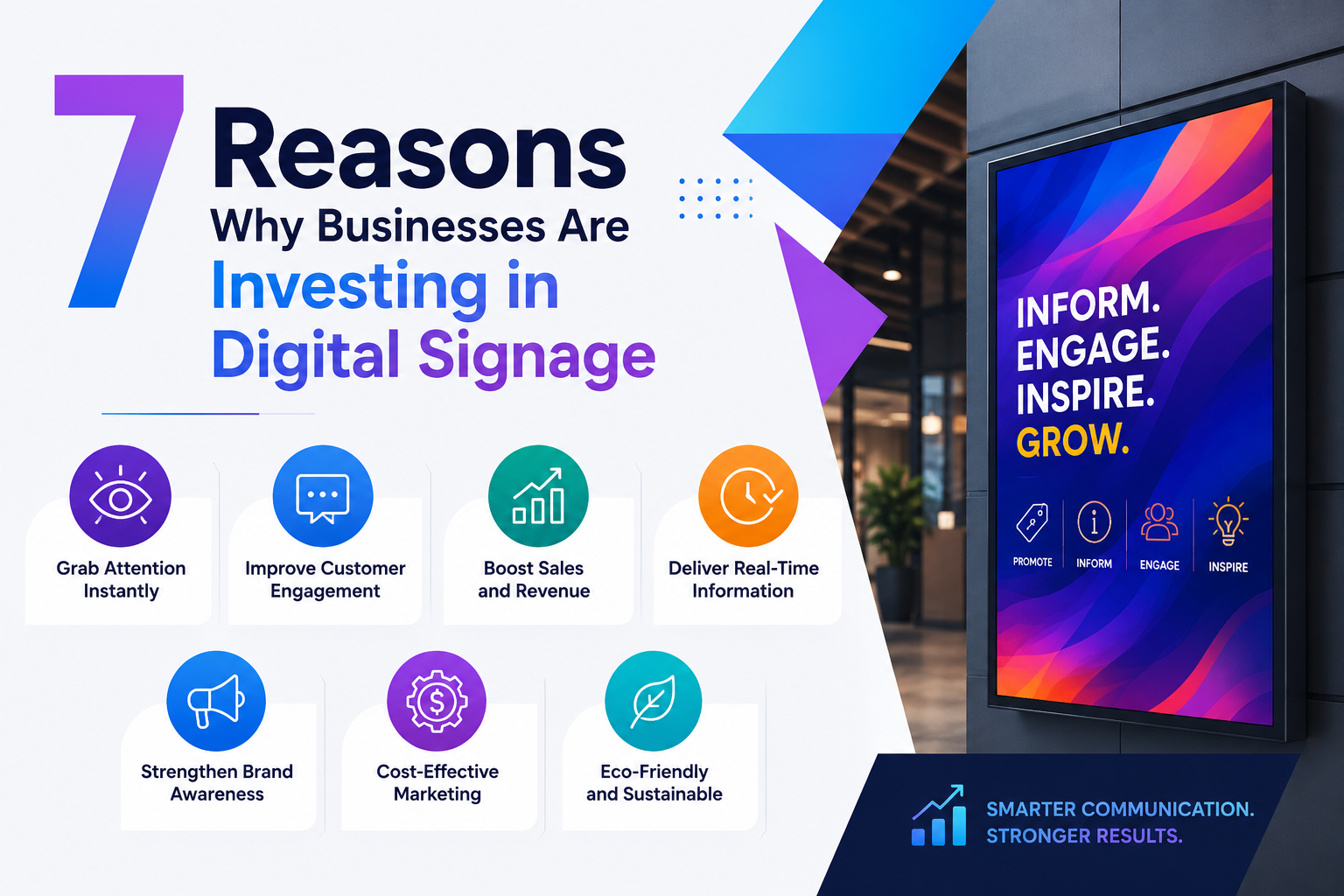
Every investment a business makes has to earn its place in the budget sooner or later, and investing in digital signage is increasingly clearing that bar with room to spare. Finance teams that once treated screens as a nice to have marketing extra are now asking for them by name, because the numbers behind business signage solutions have become difficult to ignore. Across retail, hospitality, and corporate offices, digital displays are being approved not on enthusiasm but on payback periods. The conversation has shifted from whether digital signage ROI exists to how quickly it shows up.
Here are seven reasons that decision makers keep coming back to when the budget for digital signage lands on their desk.
Seven Reasons Businesses Are Putting Money Into Digital Signage
1. The Return on Investment Is Now Measurable
Modern platforms can track what content was shown, when sales moved, and how footfall responded, which means the return on a digital signage investment is no longer a matter of opinion. Businesses adopting digital signage have reported revenue increases in the high teens percentage range alongside higher average transaction values, figures that are hard for any finance director to wave away.
2. Running Costs Are Lower Than Print Over Time
The upfront cost of screens and software understandably gets attention, but the real comparison is against years of design fees, print runs, and delivery charges for posters, menus, and price cards. Once installed, digital displays cost very little to keep current, and that gap widens every time a price changes or a promotion ends.
3. The System Scales With the Business
A single screen and a modest software subscription can grow into a network covering dozens of sites without rebuilding anything from scratch. That flexibility matters to investors and owners who want to know that money spent now will not need replacing the moment the business expands.
4. Competitors Are Already Using It
In retail, hospitality, and many corporate sectors, digital signage has moved from differentiator to baseline expectation. A business sitting next to a competitor running fresh, dynamic screens while still relying on faded posters is making an unspoken statement to every customer who notices the difference, and not the one it wants to make.
5. The Data Is Worth Almost as Much as the Display
Beyond the screen itself, signage platforms generate data on engagement, dwell time, and content performance that feeds directly into wider marketing and operational decisions. Businesses investing in digital signage often find the insight gathered is as valuable as the display benefit they originally signed up for.
6. Customers Now Expect Real Time Accuracy
A printed sign advertising a deal that ended last month does damage to trust that a business may not even notice happening. Investing in business signage solutions lets pricing, stock availability, and offers stay accurate to the minute, which matters more to today’s customers than it might have five years ago.
7. The Cost of Entry Has Dropped Significantly
Hardware prices have fallen and software has moved to flexible subscription models, which means the investment required to get started is considerably lower than it was even a few years back. Smaller businesses that previously priced themselves out of digital displays can now access much of the same technology larger chains use.
What a Typical Investment Looks Like
The numbers involved vary considerably depending on the size of the rollout, but the shape of the investment tends to follow a similar pattern. A single screen setup, covering hardware, installation, and a year of software, usually sits at the lower end of what most small businesses budget for in a year of marketing spend. A multi site rollout scales up in hardware cost but not proportionally in management time, since one person can typically run content across dozens of screens from the same dashboard. This is one of the more reassuring parts of the investment case for businesses planning to grow. The cost per screen tends to fall, not rise, as the network expands.
Sectors Leading the Investment Curve
Some sectors are investing faster than others right now. Retail and hospitality remain the heaviest adopters, driven by frequent promotional changes that make the cost savings obvious almost immediately. Healthcare has become one of the fastest growing areas of investment, largely because clearer patient communication has a direct effect on satisfaction scores and reduces pressure on front of house staff. Corporate offices are investing more cautiously but steadily, usually starting with internal communication screens before expanding into reception and meeting room displays. Wherever a business sits, the underlying logic behind the investment tends to be the same: a clear, recurring cost that digital signage can remove or reduce.
How the Investment Decision Typically Gets Made
In most businesses, the decision rarely comes down to one person being convinced by a sales pitch. It usually moves through a short, practical process: someone notices a recurring cost or frustration, a rough estimate of current print and design spend gets pulled together, a small pilot is agreed for one site or department, and the wider rollout follows once that pilot has produced real numbers rather than projections. Skipping the pilot stage is one of the more common reasons larger rollouts disappoint, since assumptions made before any screens are live rarely match how staff and customers actually use them in practice.
What This Means for Your Budget
None of this means digital signage is free, or that every screen pays for itself overnight. It means the financial case has matured to the point where a sensible business case can usually be built around hard numbers rather than a hunch. MRG Systems works with finance and operations teams directly to map out realistic costs and payback timelines before any equipment is ordered, so the investment decision is based on figures specific to the business, not industry averages.
A Few Final Thoughts
The businesses asking the sharpest questions about digital signage today are not the ones wondering if it works. They are the ones working out how quickly it pays them back, and increasingly, the answer is fast enough to make the decision an easy one.
| Ready to make digital signage part of your investment plan?
MRG Systems has been helping businesses find the right digital signage solution since 1983. Call: +44 (0)1453 820840 | Email: hello@mrgsystems.co.uk | Visit: www.mrgsystems.co.uk |
Frequently Asked Questions
What kind of return on investment can a business expect from digital signage?
Results vary by sector, but businesses commonly report revenue gains in the high single to high teens percentage range, plus measurable savings on print and design costs.
Is digital signage a capital expense or an ongoing cost?
Typically both. Screens and installation are a one off hardware cost, while the content management software runs on a monthly or annual subscription.
How long does it usually take to recover the cost of a digital signage investment?
Many businesses see print cost savings alone cover the software subscription within months, with broader sales benefits building over the following year.
Do small businesses get the same return on investment as larger chains?
Yes, proportionally. A single well placed screen in a busy independent shop can deliver a similar percentage improvement in engagement and sales as a much larger network.
What should I ask a supplier before investing in a digital signage system?
Ask about total cost over three years, not just the upfront price, along with support response times and whether the platform can grow with the business.
Does the cost per screen really fall as a business adds more locations?
Yes, in most cases. Hardware cost scales with the number of screens, but software and management time do not increase at the same rate, which lowers the average cost per screen as a network grows.